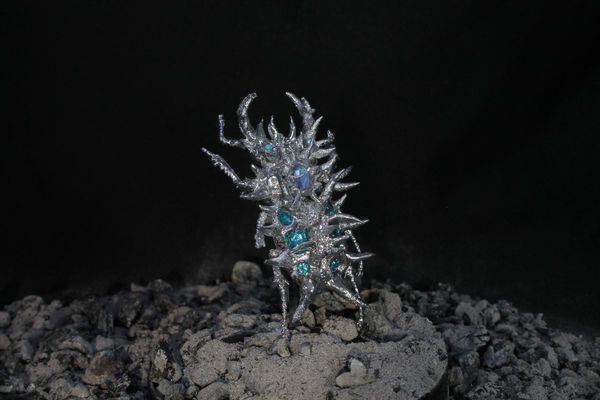
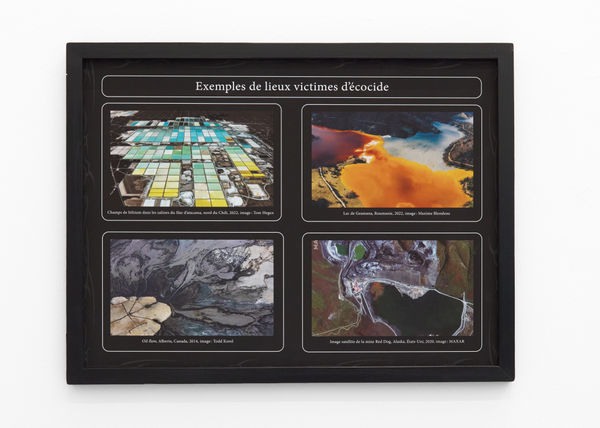
Presented at Fabienne Levy Gallery in Lausanne as part of the HEAD Gallery Prize, the exhibition Là où rien ne devait pousser is an immersive installation inspired by the fictional bestiary Deep Vermins, written by the artist in 2024. The speculative bestiary brings together fifty-two species created to survive in the toxic environments resulting from the mining extraction required to manufacture an iPhone 5S. Through this exhibition, twelve of the fifty-two species have been reproduced, and each creature embodies a hypothesis of adaptation to a post-natural era in which ecosystems are redefined by the remnants of the digital industry and the multiple forms of pollution it generates.
With the help of Stable Diffusion and ChatGPT, Elsa Wagnières creates techno-organic species conceived machines and inspired by the survival strategies of living organisms in devastated mining sites. Blending art, science, and ecological speculation, Là où rien ne devait pousser reflects on the global depletion of resources, our technological dependence, and the possible emergence of mutant life born from disaster. It is a critical fiction in which AI—an instrument of rupture—models a future ravaged by the polluting effects of that very same AI.
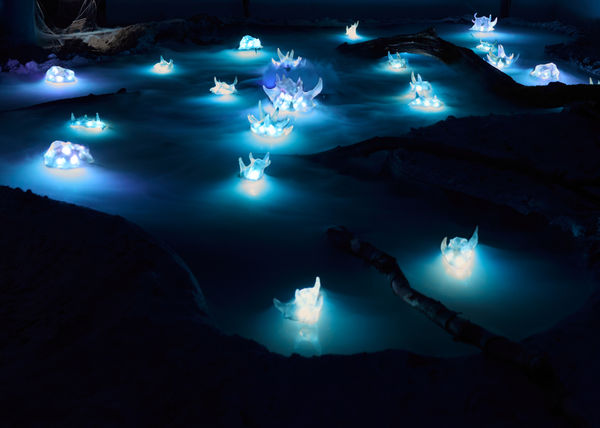
The viewer is invited to walk through and pause within a twilight space, somewhere between an archaeological cave, a post-Anthropocene laboratory, and an altered sanctuary. Sculptures, fragments, and fossil or mutant creatures coexist in a dense, sensitive atmosphere, where the living seems rewritten by the very cause of the catastrophe. As the visitor moves through the installation, it sparks reflection on our relationship to nature, technology, and the ruins of our time. It offers an experience that is both sensory and critical, inviting us to rethink the ways we inhabit the Earth and to imagine other possible futures where the artificial and the biological, the organic and the technological, coexist.
Elsa Wagnières (*1997) is a visual artist who graduated in 2024 from the Work.Master in Contemporary Artistic Practices at HEAD (Haute École d’Art et de Design) in Geneva. Her work explores the intersections between art, science, and technology, in order to imagine autonomous ecosystems that she unfolds across various media (sculpture, installation, publishing, etc.) Examining the ethical stakes of ecology and the frictions between organic and digital systems, the artist questions the place of humanity in the writing of our own future when faced with contemporary technologies, particularly artificial intelligence. Elsa Wagnières’ sci-fi universe calls for a confrontation with the complexity of living systems and a rethinking of the power dynamics at play between the natural and the artificial.
This exhibition is produced with the support of HEAD.